
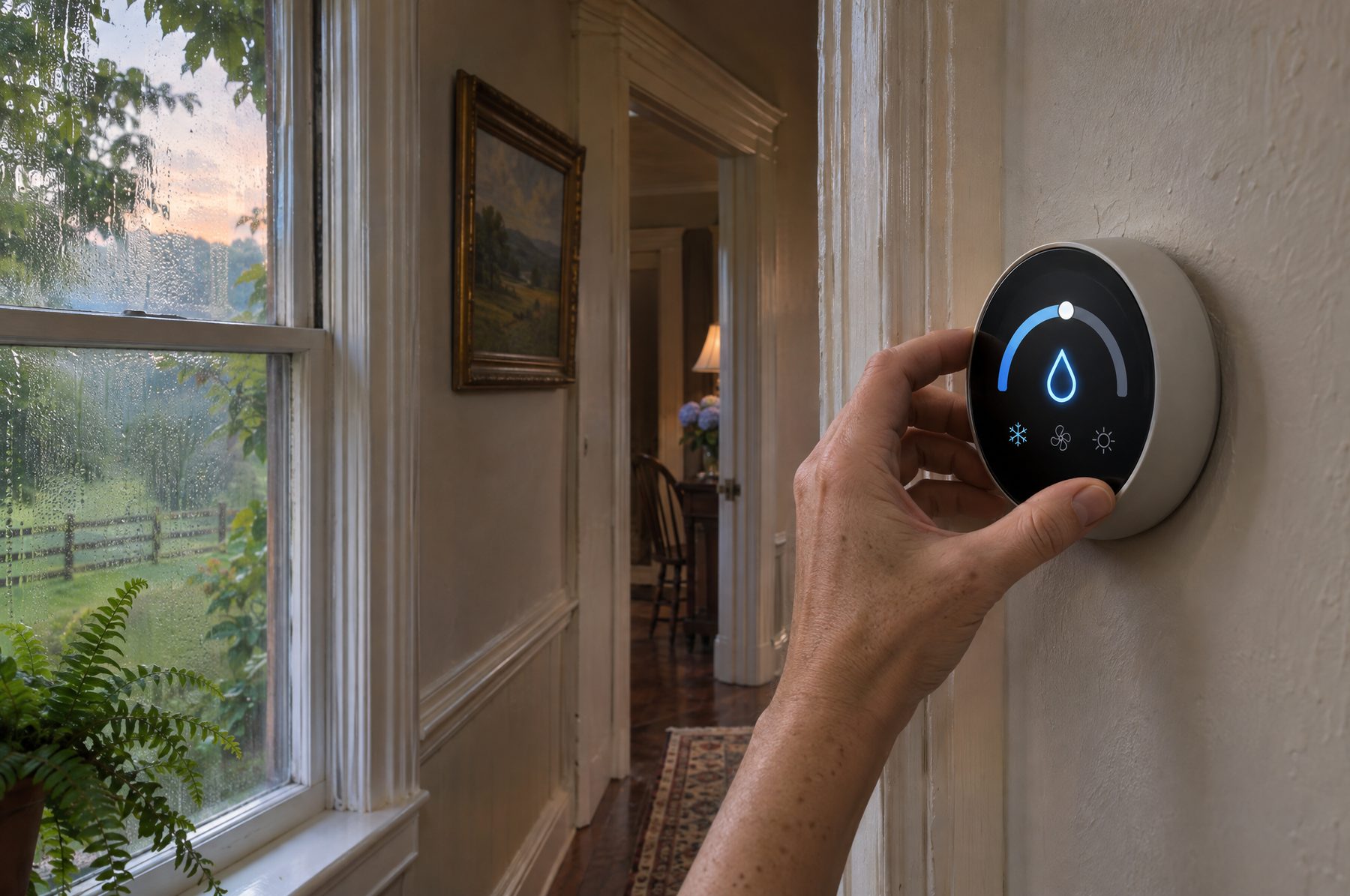
Thermostats and humidity control in Louisville, KY
If the thermostat says 72 and the house feels damp, the problem is usually humidity, not temperature. A lot of it can be fixed with the right thermostat settings. When it cannot, we add a whole house dehumidifier. And in a dual fuel house, the thermostat is also what decides when the furnace takes over.
- Humidity measured room by room
- Fan and dehumidify settings set up for July
- Dual fuel switch set from your house
- A follow-up check in the other season
Tell us what the house feels like
We usually answer the same day, and within the hour when a house has no heat or no cooling.
No heat or no cooling and someone at home is elderly, unwell or very young? Call or text now: 502-555-0147
Why 72 can feel like a basement
Comfort is temperature plus humidity. In a Louisville July the outdoor air is wet: NOAA's long-term average relative humidity at the airport is 81 percent at 7 in the morning. The air conditioner has to take that water out as well as cool the rooms.
When it does not, the house sits at the setting and still feels sticky. The common causes are a system too big for the house, a fan left on, a dehumidify feature never turned on, or a leaky return pulling in damp crawlspace air. The first is a sizing problem; the rest are fixable in an afternoon.
Most current thermostats show the indoor humidity, and many let you change the dehumidify setting from a phone. That only helps if the system behind the thermostat is set up to act on it, so we configure both ends: what the thermostat asks for and what the blower and the coil actually do.
Settings we check, by season
| Setting | Summer | Winter |
|---|---|---|
| Fan | Auto, so the coil can drain between cycles | Auto or circulate, to taste |
| Dehumidify | On, if the system supports it | Off |
| Heat pump lockout or balance point | Not used | Set from the house's heat loss, so the furnace takes the cold snaps |
| Auxiliary or emergency heat | Not used | Checked so it only runs when it should |
| Humidity readout | Watched, aim below 60 percent | Watched for very dry air |
How wet Louisville air is
NOAA's long-term average relative humidity at Louisville's airport, morning and early afternoon.
81percent
July, 7 a.m.
56 percent at 1 p.m.
85percent
September, 7 a.m.
54 percent at 1 p.m.
60percent
The EPA's indoor ceiling
Ideally 30 to 50 percent inside
Three ways to dry a house
Settings
Fan to auto, dehumidify on, thermostat in the right spot. Free, and often half the fix.
A right sized system
When the air conditioner is far too big, it never runs long enough to dry the air. The fix is at replacement time.
Whole house dehumidifier
For mild, rainy days and damp basements, when the air conditioner is not running enough to keep up.
How a thermostat and humidity visit goes
We measure.
Temperature and humidity in the main rooms, the supply air, the return.
We read the system.
What it can do: fan speeds, dehumidify, heat pump and furnace staging.
We set it up or replace it.
A new thermostat where the old one cannot do the job, wired and configured for your system.
We check it again.
A follow-up in the opposite season, when the settings that matter are different.
Where the thermostat sits matters
A thermostat reads the air around it. Put it in the wrong spot and it runs the whole house by one corner.
Not in the sun
A thermostat on a west wall or near a window thinks the house is warmer than it is on summer afternoons.
Not by a supply register
It gets blasted with cold or warm air and shuts the system off early. Short cycles mean less drying in summer.
Somewhere central
An inside wall in a room you use, away from the kitchen and the front door. Moving it is a common, inexpensive fix.
Setting up a dual fuel thermostat
In a house with a heat pump and a gas furnace, the thermostat is the referee. Three settings decide how the winter goes.
The switch point
The outdoor temperature below which the furnace takes over. Set from your house's heat loss, not a factory default.
Recovery after setback
If you turn the heat down at night, the morning warm-up can call the furnace when the heat pump would have done. We set how the thermostat recovers.
Outdoor sensor
Some systems read the outdoor temperature from a sensor, some from the internet. Either works if it is set up and checked.
Humidity control around Louisville
We drive out from Jeffersontown. Each town has its own page with the drive, the houses we see there and the office that handles the HVAC permit, because that office is not the same everywhere.
St. Matthews
About 7 miles from the office. The city wants its own Letter of Compliance before Louisville Metro issues a building permit.
Louisville
About 12 miles to the Highlands, 14 to Old Louisville. Louisville Metro Construction Review issues the HVAC permit.
Prospect
About 13.5 miles. A city in two counties, with a different HVAC permit office on each side of the line.
Mount Washington and Shepherdsville
About 12 and 21.5 miles south into Bullitt County, where permits run through the county and the city, not Louisville Metro.
Thermostat and humidity questions we hear most
What humidity should my house be?
The EPA suggests keeping indoor relative humidity below 60 percent, ideally between 30 and 50 percent. Above 60 for long stretches, mold and dust mites do well and the house feels warmer than the thermostat says. We measure it in the rooms, not just at the thermostat.
Should the fan be on or auto?
In summer, usually auto. With the fan on, water that just condensed on the indoor coil can be blown back into the house between cooling cycles. Many people set the fan to on for air circulation and wonder why the house feels damp. In winter it matters less.
What does a dehumidify setting do?
Some thermostats and systems can slow the blower when humidity is high, so the coil gets colder and pulls more water out. Others can cool a little below the setting to dry the air. Whether yours can depends on the system, and we set it up to match.
When do I need a whole house dehumidifier?
When the cooling system cannot keep humidity down on its own: mild, rainy days when the air conditioner barely runs, a basement that stays damp, or a very efficient house that needs little cooling. It ties into the ductwork and runs on its own humidity setting.
Can a smart thermostat run my dual fuel system?
Many can, if they are set up for it. The thermostat has to know it has a heat pump and a furnace, and at what outdoor temperature to switch. A thermostat installed with the wrong settings may run the furnace all winter or never use it. We set the switch point from your house.
Is there a rebate for a smart thermostat?
LG&E's current Residential Rebates program does not list thermostats. We would not count on one.
My upstairs is muggy and the downstairs is fine. What does that mean?
Usually airflow or ducts, not the thermostat. Upstairs rooms gain more heat from the roof and often get less air from long duct runs. We measure both floors. The fix may be balancing, a return upstairs, or a zoned system, and we tell you which one the numbers point to.
Tell us what the house feels like
The thermostat setting, how the house feels, and which rooms are worst in summer or winter.
Book a humidity visit
We usually answer the same day, and within the hour when a house has no heat or no cooling.
No heat or no cooling and someone at home is elderly, unwell or very young? Call or text now: 502-555-0147