
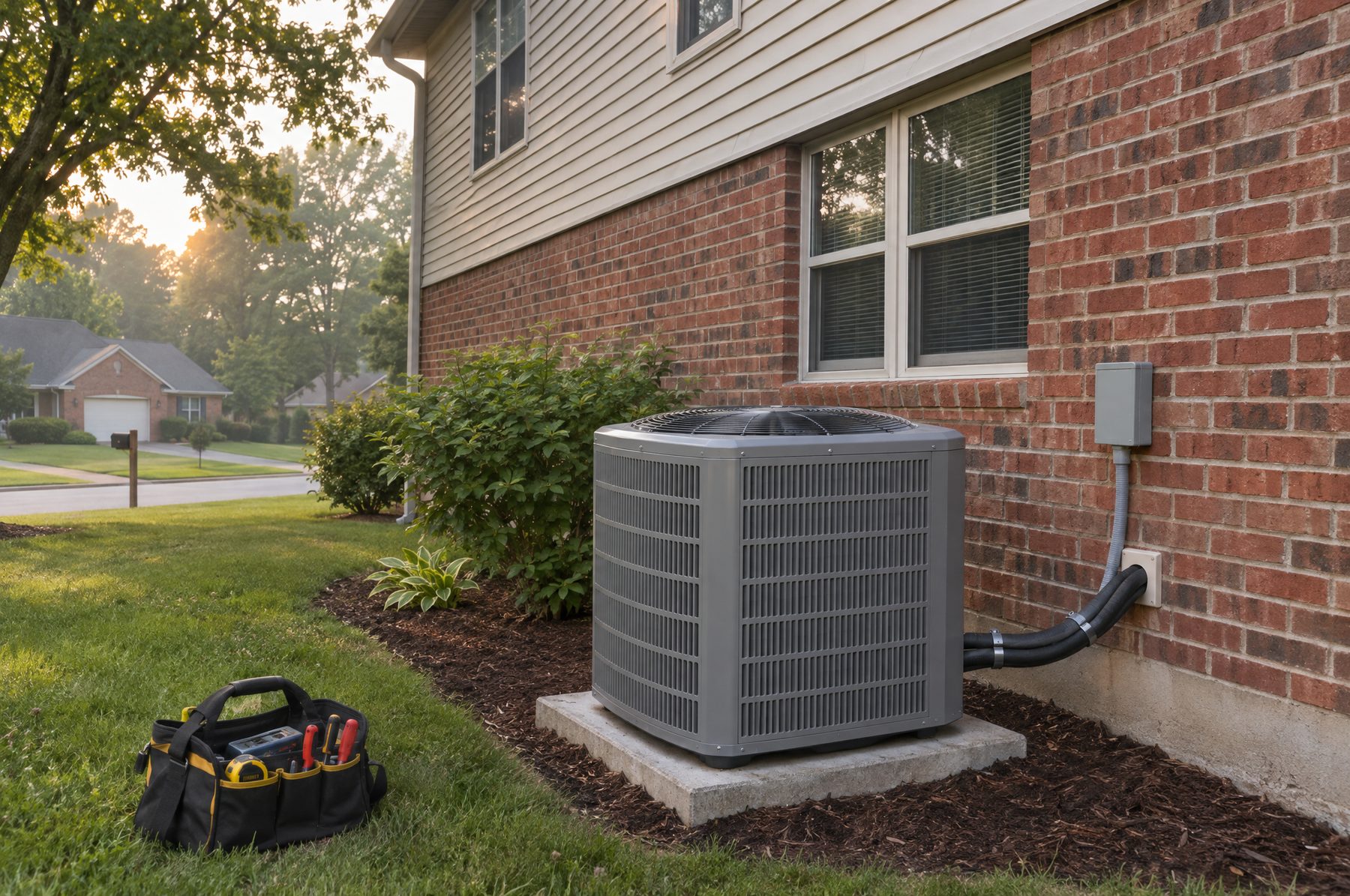
AC installation in Louisville, KY, sized to dry the house
A new air conditioner should do two jobs: cool the house and pull the water out of a Louisville summer. The second one is where an oversized system fails. We size from a room by room load calculation, not from the old unit, so the new one runs long enough to dry the air.
- Sized by a room by room load calculation
- Humidity measured before and after
- Meets the Southeast SEER2 rule
- Written price before any work
Tell us about the air conditioner you have
We usually answer the same day, and within the hour when a house has no heat or no cooling.
No heat or no cooling and someone at home is elderly, unwell or very young? Call or text now: 502-555-0147
Cold and clammy is a sizing problem
An air conditioner dries the air by running it across a cold indoor coil, where water condenses and drains away. That takes time. In the first minutes of a cycle the coil is still cooling down and pulls out very little water.
A system that is too big for the house reaches the thermostat setting in a few minutes and shuts off. The rooms are cool, the air is still wet, and the house feels like a basement. The fix is a system sized so it runs longer, steadier cycles. The EPA suggests keeping indoor humidity below 60 percent, ideally between 30 and 50.
Most replacements take a day. Jobs that add a return, change the duct layout or move the outdoor unit take longer, and the quote says so. Either way, the last hour of the visit is spent measuring: supply air temperature, humidity in the rooms, and the refrigerant charge, so you see the system doing both jobs before we leave.

How an AC installation goes
We measure the house.
Temperature and humidity in the rooms, the ducts, the old system's airflow.
Load calculation and quote.
Room by room. You get the size, the efficiency and a written price.
Installed in a day, most of the time.
New outdoor unit, indoor coil matched to it, line set, drain, electrical, permit.
Checked when it is hot.
Charge, airflow and humidity checked under real summer load, then again before the next one.
What a Louisville summer asks of an air conditioner
NOAA's 1991 to 2020 normals at the airport, and NOAA's long-term humidity averages.
89°F
Normal July high
With a normal July low of 70.8
42.7days
At 90°F or above in a normal year
35.5 of them in June, July and August
81percent
Average July morning humidity
Long-term average at 7 a.m., 56 percent at 1 p.m.
What should be on an AC quote
If a quote is missing one of these, ask for it.
| Line | Why it matters |
|---|---|
| Load calculation result | The size should come from the house, not from the old unit's label. |
| Matched indoor coil | An outdoor unit is rated with a specific coil. A mismatch can miss the rating. |
| SEER2 rating | At least 14.3 below 45,000 Btu per hour in Kentucky. |
| Refrigerant | Which one, and whether the equipment is the newer kind or pre-2025 stock. |
| Drain and safety switch | The condensate drain carries the water out; a float switch shuts the system down if it backs up. |
| Permit | Who pulls it and from which office. |
Three ways to replace an air conditioner
Air conditioner and coil
The straight replacement. The furnace stays and keeps heating. Right when the furnace is in good shape and you want to keep gas heat.
Heat pump instead
Same cooling, plus heating on mild and cool days, with the furnace as backup. Often the better long-term choice when the furnace is aging.
Variable speed
Runs at low speed most of the time, which suits humidity removal well. Worth it in houses that have fought dampness for years.
What goes into a load calculation
A load calculation works out how much heat each room gains on a summer afternoon and loses on a winter night. It is the basis for the size on our quote, and we leave you a copy.
The house
Wall and attic insulation, window sizes and which way they face, the basement, how leaky the house is.
The rooms
Each room on its own, so the airflow to every register can be planned, not only the total.
The people and the use
How many live there, a home office full of screens, a kitchen that cooks every night. All of it adds heat and moisture.
AC installation around Louisville
We drive out from Jeffersontown. Each town has its own page with the drive, the houses we see there and the office that handles the HVAC permit, because that office is not the same everywhere.
St. Matthews
About 7 miles from the office. The city wants its own Letter of Compliance before Louisville Metro issues a building permit.
Louisville
About 12 miles to the Highlands, 14 to Old Louisville. Louisville Metro Construction Review issues the HVAC permit.
Prospect
About 13.5 miles. A city in two counties, with a different HVAC permit office on each side of the line.
Mount Washington and Shepherdsville
About 12 and 21.5 miles south into Bullitt County, where permits run through the county and the city, not Louisville Metro.
AC installation questions we hear most
Why not just replace it with the same size?
Because the old size may never have been right, and the house has likely changed since: new windows, attic insulation, a finished basement. A system that is too big cools quickly, shuts off, and leaves the air damp. A load calculation sizes it to the house you have now.
What efficiency does a new air conditioner need in Kentucky?
Kentucky is in the Department of Energy's Southeast region. Split system central air conditioners installed here since January 1, 2023 must reach 14.3 SEER2 if they are under 45,000 Btu per hour and 13.8 SEER2 at or above that. In the Southeast the rule goes by the date it is installed, not the date it was made.
Do new air conditioners use a different refrigerant?
Yes. Since January 1, 2025, new residential systems have to use refrigerants with a lower global warming potential, which moved the industry away from R-410A. Equipment whose parts were all made or imported before January 1, 2025 may still be installed under the current federal rule. We tell you which kind we are quoting.
Should I get a heat pump instead?
Worth asking. A heat pump is an air conditioner that can also run in reverse to heat. If your furnace is aging or you want lower winter gas use, a heat pump with the furnace as backup may suit the house better. See heat pumps.
Is there a rebate?
LG&E's Residential Rebates program lists central air conditioners among the equipment it covers for eligible customers. We do not quote amounts, which the utility sets; check its page or ask us. The federal 25C tax credit ended for systems placed in service after December 31, 2025.
Do I need a permit?
A replacement usually needs an HVAC permit, and who issues it depends on the address: Jeffersontown has its own, Louisville Metro covers most of Jefferson County, Bullitt County runs its own program. We pull it as part of the job. See the town pages, starting with Louisville.
Can you install a new air conditioner on my old furnace?
Usually, if the furnace blower can move the airflow the new system needs and the furnace has years left in it. We check the blower and the coil cabinet space. If the furnace is near the end, we will show you the numbers for replacing both together, or for a heat pump with a new furnace as backup.
Tell us about the air conditioner you have
Its age if you know it, whether the house feels damp in summer, and which rooms run warm.
Book an AC quote
We usually answer the same day, and within the hour when a house has no heat or no cooling.
No heat or no cooling and someone at home is elderly, unwell or very young? Call or text now: 502-555-0147